Shipping Container Sizes and Dimensions Guide
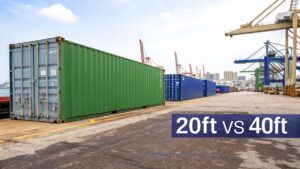
When it comes to shipping containers, the 20ft and 40ft standard dry units dominate global freight. These ISO-standard workhorses form the backbone of international logistics, ensuring cargo moves seamlessly across ships, trucks, and trains.
Quick Reference: Standard Container Dimensions
Here’s a cheat sheet of the most common container sizes. Use these figures for initial planning—whether you’re shipping dense machinery or light, bulky items.
Pro Tip: Always check internal dimensions when planning cargo. External sizes matter for transport compatibility, but internal space determines whether your goods fit.
Why Standardization Matters
Global shipping runs on ISO standards, which guarantee consistency worldwide. A container loaded in Shanghai fits seamlessly onto a truck in Rotterdam or a train in Chicago. This uniformity underpins efficient freight forwarding.
Understanding the TEU
The industry uses the TEU (Twenty-foot Equivalent Unit) to measure volume, with one 20ft container equal to 1 TEU and a 40ft equal to 2 TEUs.
For perspective: in 2022, Dubai Port handled nearly 16.8 million TEUs—a scale that highlights how vital this simple metric is to global trade.
The 20ft Standard Dry Container
The 20ft container is the foundation of the TEU system. Compact yet strong, it’s ideal for dense, heavy cargo such as machinery, raw materials, or bagged goods.
Typical Specs:
- Internal Length: 5.90 m (19 ft 4 in)
- Internal Width: 2.35 m (7 ft 8 in)
- Internal Height: 2.39 m (7 ft 10 in)
- Cubic Capacity: 33.2 m³ (1,172 cu ft)
- Max Payload: ~25,000 kg (~55,125 lbs)
Loading Reality:
- Fits 11 Euro pallets or 9–10 Standard pallets.
- Suited for heavy shipments where weight maxes out before space.
40ft Standard vs. 40ft High Cube
When you outgrow a 20ft, the 40ft container is next. Two main types exist:
- Standard (2.59 m / 8 ft 6 in tall)
- High Cube (2.90 m / 9 ft 6 in tall)
That extra foot in a High Cube adds ~13% more volume—from 67.7 m³ to 76.4 m³—without changing the max payload (~26,500 kg).
When to Choose High Cube:
- Bulky, lightweight cargo (furniture, electronics, textiles).
- Tall items (machinery, oversized equipment).
- Shipments where one High Cube avoids the cost of booking two containers.
Specialized Containers
For cargo that doesn’t fit the standard mold, specialized units provide tailored solutions:
- Open Top: Flexible roof for crane loading; ideal for tall machinery or pipes.
- Flat Rack: Strong base with open sides for oversized loads like vehicles or timber.
- Reefer (Refrigerated): Temperature-controlled from -30°C to +30°C for perishables, pharmaceuticals, or frozen goods.
Specs Snapshot:
| Type | Size | Internal Dimensions (L×W×H) | Use Case |
| Open Top | 20ft | 5.89 × 2.34 × 2.35 m | Tall machinery |
| Open Top | 40ft | 12.03 × 2.34 × 2.35 m | Pipes, scrap metal |
| Flat Rack | 20ft | 5.61 × 2.22 × 2.21 m | Large vehicles |
| Flat Rack | 40ft | 11.76 × 2.22 × 1.95 m | Boats, lumber |
| Reefer | 20ft | 5.44 × 2.29 × 2.27 m | Frozen food |
| Reefer | 40ft HC | 11.59 × 2.29 × 2.55 m | Pharmaceuticals |
How to Pick the Right Container
Choosing a container isn’t about memorizing specs—it’s about matching your cargo’s needs. Ask:
- Volume: What’s the total m³?
- Weight: Will you max payload before space?
- Largest Item: Does it fit through the doors and under the ceiling?
- Pallets: Do Euro or Standard pallets fit efficiently?
Example: A three-bedroom household move almost always calls for a 40ft High Cube—the extra foot makes space for tall furniture and bulky goods without exceeding weight limits.
FAQs
Q: Internal vs. external dimensions—what matters?
A: External = transport fit. Internal = usable space for your cargo. Always plan with internal.
Q: How many pallets fit?
- 20ft: 11 Euro or 9–10 Standard pallets.
- 40ft: 23–24 Euro or 20–21 Standard pallets.
Note: Volume doubles, but payload doesn’t.
Q: Are dimensions the same worldwide?
Yes—ISO standards keep external sizes uniform. Small variations exist in tare weight and internal measurements.
Q: What does TEU mean?
Twenty-foot Equivalent Unit—1 TEU = 20ft container, 2 TEUs = 40ft container. The universal yardstick of global trade.
Final Word
Picking the right container size saves money, prevents delays, and ensures safe delivery. At DASA Going Beyond, we simplify the process—matching your cargo with the perfect container and managing every step of your move.